
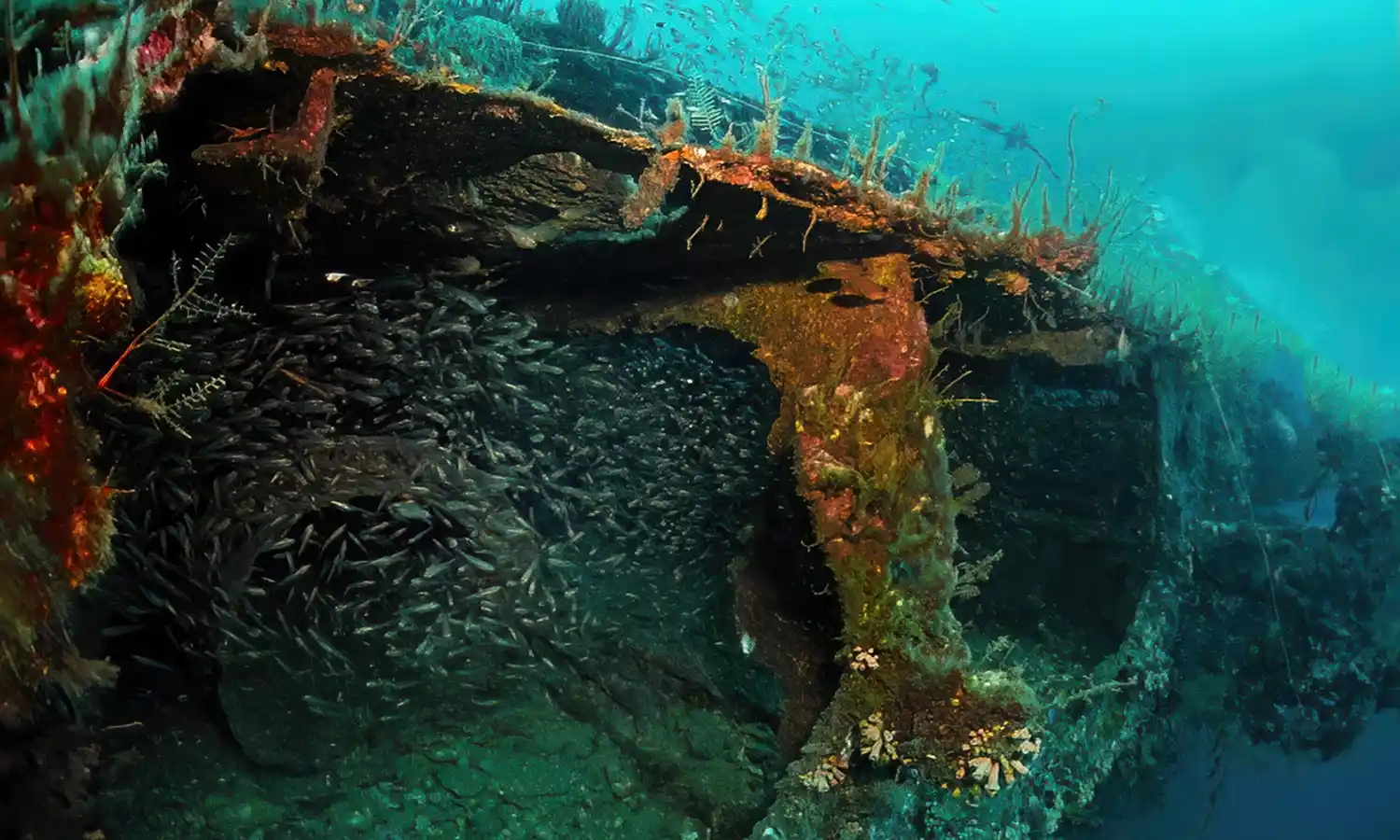
Four major shipwrecks off Borneo
The 4 wrecks of Labuan
Four deep shipwrecks sit on the seabed off Labuan. They offer Advanced divers a mix of Pacific War history and massive artificial reefs a short flight from Kota Kinabalu.
Highlights
- Four distinct shipwrecks located between 21 and 34 kilometres offshore
- Two vessels lost during the Second World War
- Two large commercial ships sunk in the early 1980s
- Dense coral growth attracting massive schools of pelagic fish
- Strict requirement for Advanced Open Water certification
- Best accessed via a short flight from Kota Kinabalu
The diving here is straightforward to define. You have four large ships sitting on the seabed off Labuan. You reach them by flying into the territory on a short flight from Kota Kinabalu. Each ship has a name and a documented story. There is a US Navy minesweeper lost in 1945. You will find a Dutch passenger ship whose identity divers argued over for decades. A cement freighter sits almost intact on the sand. A fishing vessel lies on its side in deeper water. These are Advanced dives featuring depth and strong ocean currents. You need to plan 2 or 3 days to dive them properly.
Why Labuan
Labuan is a federal territory comprising the main island and six smaller islands in the South China Sea. It sits 8 kilometres off the northwest coast of Borneo. The territory is fully duty-free. The local economy relies heavily on offshore supplies and banking. The area also cultivates a highly specialised dive industry. Labuan is not a mass-market reef destination. It commands respect among wreck divers due to the presence of four major shipwrecks. The Malaysian national heritage department officially recognised these 4 sites as protected zones in 2011. The Labuan Marine Park encompasses the waters around Pulau Kuraman, Pulau Rusukan Besar and Pulau Rusukan Kecil. Divers entering these protected zones pay a conservation fee. The island also offers rich topside history as the focal point for the Allied amphibious invasion to liberate Borneo in 1945.
The Cement Wreck
Skill level: Advanced Open Water under local operator requirements | Ave depth: Not specified | Max depth: 32 m | Current: Moderate surface currents | Visibility: 10 to 15 m
The MV Tung Hwang is a 2,650-ton Japanese freighter. The 92-metre ship struck the submerged Samarang Banks in September 1980 while transporting cement for a new palace in Brunei. The crew attempted to limp toward Labuan for emergency repairs. The vessel foundered 21 kilometres from the island. Everyone evacuated safely. The ship settled upright on a hard sandy seabed. The roof of the wheelhouse rests at 14 metres. The masts reach up to 8 metres below the surface. This verticality allows you to conduct multi-level profiles. The shallow depth facilitates explosive coral growth. The top half is an established coral garden covered in hard corals, ferns and sponges. Dense schools of small barracudas and yellowfin fusiliers patrol the masts. The site offers the highest probability among the Labuan wrecks for encountering passing whale sharks (Rhincodon typus) in season. Penetration of the wheelhouse and accommodation blocks requires appropriate wreck-penetration training. Divers must maintain awareness of snagged commercial fishing nets shrouding the upper structures.
The American Wreck
Skill level: Advanced Open Water | Ave depth: Not specified | Max depth: 33 m | Current: Moderate to strong | Visibility: 10 to 25 m
This vessel is the USS Salute (AM-294). The 54.8-metre Admirable-class oceangoing minesweeper was built for the United States Navy in Seattle. It cleared 143 Japanese naval mines and earned five battle stars during the Philippines Campaign. The ship struck a submerged Japanese contact mine on 7 June 1945 during a pre-invasion sweep of Brunei Bay. The explosion buckled the ship amidships. It broke in half and sank just after midnight. Nine crew members lost their lives. The wreck rests on a hard sand bottom. The bow section is folded backward across the main deck at a 45-degree angle. The severe structural damage presents extreme overhead hazards. Dive operators discourage internal penetration due to the collapse risk. Soft corals and feather stars encrust the twisted wreckage. Large schools of batfish and barracudas use the deformed hull plates for shelter. United States Navy divers recovered artefacts from the site in 2016.
The Australian Wreck
Skill level: Advanced Open Water | Ave depth: Not specified | Max depth: 35 m | Current: Moderate | Visibility: Often below 10 m
Local dive lore long maintained this vessel was sunk by an Australian bomber and the name has stuck. Historical registers identify the ship as the SS De Klerk. The 1,986-ton passenger and cargo steamer was built in Amsterdam in 1900. The Royal Dutch Navy scuttled the ship in 1942. The Japanese navy salvaged the vessel and renamed it the Imaji Maru. The ship struck a submerged contact mine on 16 September 1944. The explosion killed 339 people. Documentation confirms the casualties were five Japanese crew and 334 local labourers. The holds did not contain prisoners of war. Over 700 individuals were rescued. The site is an official maritime war grave. The 91.4-metre ship rests entirely on its port side at a severe 50-degree list. Eight decades of submersion have stripped all timber decking away. This deterioration leaves a haunting steel skeleton. Exploring beneath the steel cross-thwarts calls for appropriate overhead training. True penetration into the lower silted cargo holds remains perilous. The vessel is actively collapsing under its own weight. Resident marine life in the dark holds includes large lionfish, frogfish (Antennarius spp.) and marbled rays.
The Blue Water Wreck
Skill level: Deep Diver Specialty | Ave depth: Not specified | Max depth: 35 m | Current: Moderate | Visibility: Up to 40 m
The MV Mabini Padre was an 80-metre Philippine stern-fishing trawler. A severe fire broke out on board in November 1981. The vessel foundered while under tow. The crew survived. This site sits 34 kilometres northwest of Pulau Kuraman. It is the furthest wreck from the Labuan mainland. The remote position shields it from coastal river run-off. Visibility occasionally reaches up to 40 metres on favourable days. The massive trawler rests prominently on its port side. The elevated starboard side rises to a depth of 24 metres. The ship remains structurally intact. It retains its original masts and imposing superstructure. The route through the stern trawl chute to the massive single screw requires appropriate overhead training. The interior machine spaces possess severe rust-out and silting hazards. The elevated starboard hull has transformed into an undersea garden. Crinoids and ascidians colonise the metal. The structure attracts immense schools of jacks and barracudas.
How the dives are run
Labuan is a specialist add-on destination unapologetically built for Advanced divers. Wreck diving here is not serviced by high-volume storefronts. Dive operators run scheduled charters based on strict minimum passenger numbers. They require at least 4 divers to dispatch a boat. You must confirm your dates via direct enquiry well ahead of time. The speedboat transit to the offshore wrecks takes 40 to 60 minutes over open water. Operators limit itineraries to 2 dives per day. The schedule leaves time for extended surface intervals after deep profiles. Operators enforce a strict policy of no refunds if you abort a dive upon reaching the site. This rule applies to seasickness and general discomfort in the open-ocean conditions. Make sure your travel information planning accounts for this working reality.
What you see
The waters surrounding Labuan are inherently more turbid than oceanic drop-offs. Baseline visibility across the three closer wrecks averages between 10 and 15 metres. This moderate turbidity carries high concentrations of plankton. The nutrient-rich environment feeds hyper-dense Dendronephthya soft corals. The wrecks function as massive artificial reefs. Surveys indicate the structures support over 160 marine species. You can see dense schooling fish alongside macro subjects including nudibranchs and porcelain crabs. The nearby Labuan Marine Park reefs offer shallow coral gardens. You can encounter turtles and juvenile reef sharks in the protected zones around Pulau Kuraman.
Photography
The marine environment creates a highly specific aesthetic for wide-angle underwater photography. The mint-green water provides a striking contrast against the pastel pink and orange corals. Underwater photographers face intense backscatter challenges on the deeper WWII sites. Divers mastering ambient lighting can capture spectacular silhouettes of the degrading hulls. The Cement Wreck yields exceptional imagery due to its intact upright structure and shallow depths.
The level they ask for
These dives push the boundaries of recreational diving limits. The seabed for all 4 wrecks lies between 32 and 35 metres. Local operators strictly require an Advanced Open Water certification. You must present a logbook proving a minimum of 40 to 50 lifetime dives. Deep Diver specialty training helps you prepare for the Blue Water Wreck's depth and the need for careful air and no-decompression limit planning. A medical clearance questionnaire is mandatory. Divers who have been inactive for extended periods must submit to a check dive.
When to go
Water temperatures fluctuate narrowly between 25 and 30 degrees Celsius. You can check when to dive Sabah for general trends across the state. The most reliable window for Labuan is the West Coast Sabah dry season from March through May. This period offers the most stable surface conditions for the long boat runs. Smooth crossings minimise the risk of weather-related dive cancellations.
How to combine it
You can add diving in Labuan easily to a stay in Kota Kinabalu. Daily flights operate from Kuala Lumpur International Airport and Kota Kinabalu. The direct passenger ferry service from Jesselton Point is suspended indefinitely. Travellers opting for maritime transport must now take a bus 2 hours south to the Menumbok ferry terminal. Flying remains the most efficient method. You can also build Labuan into a Sabah Grand Dive Tour. The territory pairs well logically with a Sarawak Wrecks & Reefs itinerary. Wreck divers seeking an alternative on the east coast should consider the Lankayan wrecks.
Plan your wreck days
Send your dates along with the names of everyone coming and your certification levels. The team comes back with what can be arranged for a Labuan itinerary.
FAQ
Where are the Labuan wrecks located?
Do I need a special certification?
Are there penetration routes?
What is the water temperature?
How do I get to Labuan?
Make a Booking for Labuan
Sources referenced on this page: United States Navy; Naval History and Heritage Command; Department of Fisheries Malaysia; X-Ray Mag. Facts verified 2026-09-06.