

The animals of Sabah
Marine life of Sabah
What lives in Sabah's water, from the turtles and sharks of Sipadan's walls to the thumbnail-sized animals the guides find on Mabul's sand.
Highlights
- See resident green and hawksbill turtles on almost every dive at Sipadan.
- Dive Mabul and Kapalai for flamboyant cuttlefish, mimic octopuses and ghost pipefish hiding in the sand.
- Find schooling chevron barracuda and bigeye trevally waiting in the currents along the oceanic drop-offs.
- Visit Lankayan Island in the Sulu Sea for its famous jawfish colonies and seasonal whale sharks.
- Look for banded sea kraits hunting in the coral crevices of Pulau Tiga.
- Choose the outer islands for pelagic fish or the coastal sites for rare macro photography.
Overview
Sabah's waters hold some of the most diverse marine life you can find anywhere. A short boat ride from Semporna takes you to Sipadan, Mabul and Kapalai. These islands offer completely different underwater habitats within 15 minutes of each other. Green turtles rest on the ledges and grey reef sharks cruise the walls on almost every dive. Closer to shore the sandy slopes hide animals the size of your thumbnail. The big animals decide which island you dive and the small ones decide which guide you want.
This index sets out where each animal is found and when to look for it. The guides working on these islands have spent years memorising the reef crevices and sand flats to locate animals that rely entirely on camouflage. Sabah Parks issues 254 Sipadan permits a day to protect the larger species. A guaranteed Sipadan permit comes with the right combination of resort, dive package and minimum number of nights. The team steers you to the combination that fits your dates.
How to use this index
This page groups the marine life of Sabah by type so you can see where each species lives. The tables show you the locations, the seasons and how often the animals are seen based on local dive logs. Follow the links for dedicated guides on how to photograph and dive with each animal safely.
Turtles
Sabah is a major sanctuary for sea turtles. The coral walls and shallow seagrass beds provide excellent feeding grounds.
| Animal | Where in Sabah | When | How often | Link |
|---|---|---|---|---|
| Green turtle | Sipadan, Mabul, Lankayan | All year | Resident | Green turtle |
| Hawksbill turtle | Sipadan, Mabul, Tun Sakaran | All year | Resident | Hawksbill turtle |
Turtles are seen on almost every dive at Sipadan. They sleep on the ledges of the wall and swim past divers in the shallows. Several resorts run active turtle hatcheries to protect the eggs from predators. Pom Pom Island Resort, Mataking Island Resort, Borneo Divers Mabul Resort and Lankayan Island Dive Resort all have dedicated conservation areas.
Sharks and rays
The deep water and strong currents attract large open-water fish while resident rays rest in the sandy shallows.
| Animal | Where in Sabah | When | How often | Link |
|---|---|---|---|---|
| Grey reef shark | Sipadan | All year | Resident | Grey reef shark |
| Whitetip reef shark | Sipadan | All year | Resident | Whitetip reef shark |
| Whale shark | Lankayan | March to September; resort closed January and February | Occasional | Whale shark |
| Scalloped hammerhead | Outer reefs, Layang Layang | March to May | Rare | Scalloped hammerhead |
| Spotted eagle ray | Si Amil, Sipadan | All year | Regular | Spotted eagle ray |
| Bluespotted ribbontail ray | Mabul, Kapalai, TARP | All year | Resident | Blue-spotted rays |
| Marbled ribbontail ray | Sipadan | All year | Regular | Blue-spotted rays |
Spotted eagle rays use their shovel-shaped snouts to dig for hard-shelled invertebrates on the sandy ledges of Sipadan. Si Amil has recently been designated an Important Shark and Ray Area because large groups of eagle rays gather there. Dive logs record aggregations of three to 32 individuals around the Pinnacle dive site. The bluespotted ribbontail ray hides under table corals in the shallows of Mabul while the massive marbled ribbontail ray rests in the deep caves of Sipadan. Whale sharks pass through the Sulu Sea near Lankayan between March and September and are seen occasionally.
The schooling fish
The currents at Sipadan bring large groups of predatory fish together.
| Animal | Where in Sabah | When | How often | Link |
|---|---|---|---|---|
| Chevron barracuda | Sipadan | All year | Resident | Chevron barracuda |
| Bigeye trevally | Sipadan | All year | Resident | Bigeye trevally |
The resident chevron barracuda school at Sipadan is famous for tightening into a large spinning column when the currents run strong. Getting level with the school provides excellent photography opportunities. Bigeye trevally form similar metallic walls off South Point and Barracuda Point.
The reef characters
These are the large distinctive fish and reptiles that dominate the coral slopes.
| Animal | Where in Sabah | When | How often | Link |
|---|---|---|---|---|
| Napoleon wrasse | Sipadan | All year | Resident | Napoleon wrasse |
| Bumphead parrotfish | Sipadan | All year | Resident | Bumphead parrotfish |
| Titan triggerfish | Sipadan, Mabul, TARP | All year | Resident | Titan triggerfish |
| Banded sea krait | Pulau Tiga, Sipadan, Mabul | All year | Abundant | Banded sea krait |
| Moray eels | Sipadan, Mabul | All year | Resident | Moray eels |
| Anemonefish | Everywhere | All year | Abundant | Anemonefish |
The Napoleon wrasse is the largest member of the wrasse family. Females transition to males around age nine and develop a prominent forehead hump alongside bright blue and green colours. Sipadan protects a large population of these fish from the commercial live-fish trade. Titan triggerfish are known for fiercely defending their nests in the rubble. Females defend an invisible cone of aggression radiating upwards to the surface. You must swim horizontally away from the nest to escape an attack.
Banded sea kraits are amphibious snakes that hunt cryptic eels in the coral crevices. Their small heads fit into narrow reef crevices. These snakes are highly venomous but exceptionally docile. Pulau Tiga has an enormous population reaching up to 76 snakes per square kilometre. The giant moray lives in the deep limestone crevices of Sipadan. The ribbon eel lives in constructed sand burrows at Mabul and changes colour from black to blue to yellow as it ages. Anemonefish populate the shallow reefs everywhere. They live in a strict hierarchy governed by a single dominant female.
Cephalopods
Mabul and Kapalai are global centres for cephalopod diversity.
| Animal | Where in Sabah | When | How often | Link |
|---|---|---|---|---|
| Flamboyant cuttlefish | Mabul, Kapalai | All year | Regular | Flamboyant cuttlefish |
| Mimic octopus & Wonderpus | Mabul | All year | Moderate | Mimic octopus & wonderpus |
| Blue-ringed octopus | Mabul | All year | Moderate | Blue-ringed octopus |
| Bobtail squids | Mabul (Night dives) | All year | Moderate | Critters of Semporna |
The flamboyant cuttlefish has a highly reduced cuttlebone and walks across the sand using its lower arms. When threatened it pulses with bright yellow and red warning colours. The flesh of this cuttlefish is reported to be toxic. The mimic octopus contorts its body to look like venomous flatfish or sea snakes to deter predators while foraging in the open. The wonderpus has a fixed pattern of white spots on a rusty red background. Bobtail squids bury themselves during the day and emerge at night. They use a colony of bioluminescent bacteria in their mantle cavity to match the moonlight and mask their silhouettes from below. Finding them requires a guide who knows how to spot their tiny eyes in the periphery of a torch beam.
Macro fishes
The sandy environments of Mabul and the coral rubble of Lankayan host fish that rely entirely on camouflage.
| Animal | Where in Sabah | When | How often | Link |
|---|---|---|---|---|
| Ghost pipefish | Mabul, Kapalai, Lankayan | All year | High | Ghost pipefish |
| Crocodilefish | Mabul | All year | High | Crocodilefish |
| Frogfish | Mabul, Kapalai | All year | High | Frogfish |
| Leaf scorpionfish & Rhinopias | Lankayan, Mabul | All year | Rare to Moderate | Leaf scorpionfish & rhinopias |
| Jawfish | Lankayan (Jawfish Lair) | All year | Very High | Jawfish |
| Mandarinfish | Mabul, Kapalai, Pom Pom Island | Dusk | High | Mandarinfish |
| Pygmy seahorse | Sipadan, Mabul | All year | Moderate | Pygmy seahorse |
Ghost pipefishes mimic crinoids or dead leaves swaying in the current. The ornate ghost pipefish associates with feather stars while the robust ghost pipefish adopts a smoother shape to mimic decaying seagrass. Pregnant females fuse their pelvic fins to form a brood pouch for incubating eggs. Crocodilefish wait on the seabed to ambush passing prey. They lie flat on the sand with fringes over their eyes that disguise the shape of their pupils.
Lankayan is famous for the Jawfish Lair where male dendritic jawfish incubate fertilised eggs in their mouths for several weeks. The males hover vertically above their burrows and periodically spit the egg mass out for a few seconds to aerate it. Rhinopias are prized finds for muck divers. These rare scorpionfish look like scraps of weed swaying on the seabed and are occasionally spotted on the Mabul sand flats. They periodically shed their outer skin to clear away algae.
Crustaceans
The artificial structures and rubble fields support specialised crustaceans.
| Animal | Where in Sabah | When | How often | Link |
|---|---|---|---|---|
| Harlequin shrimp | Darvel Bay, Mabul | All year | Rare to Moderate | Harlequin shrimp |
| Mantis shrimp | Lankayan, Mabul, Kapalai | All year | Moderate to High | Mantis shrimp |
Harlequin shrimp are striking predators that hunt much larger sea stars. They live in monogamous pairs and drag amputated limbs back to their lairs to feed slowly. Mantis shrimps possess the most complex visual system in the animal kingdom and perceive circular polarised light. Heavy-shelled smasher varieties build U-shaped burrows and strike with the speed of a bullet to crack open sea snails. Spearer varieties prefer the soft bottoms of Mabul and bury themselves vertically to impale passing fish. You must approach them slowly to avoid startling them back into their holes.
Nudibranchs
Sabah is a fantastic place to look for colourful sea slugs.
| Animal | Where in Sabah | When | How often | Link |
|---|---|---|---|---|
| Nudibranchs and Spanish dancer | Mabul, Kapalai, Lankayan | All year | Very High | Nudibranchs and spanish dancer |
Nudibranchs are seen on almost every dive at Mabul. The guides regularly point out numerous species on a single dive at sites like Froggy Lair. The large Spanish dancer swims by rippling its brilliant red mantle. Smaller species like Chromodoris magnifica feed heavily on sponges while the solar-powered Pteraeolidia ianthina gets energy from tiny algae living inside its body. Photographers use macro lenses to capture the intricate gills and sensory horns of these tiny sea slugs.
Which island for which animal
The marine environment varies sharply depending on the island you choose.
| Location | Best known for |
|---|---|
| Sipadan | Oceanic walls, green turtles, reef sharks, schooling barracuda |
| Mabul and Kapalai | Sandy muck diving, flamboyant cuttlefish, frogfish, ghost pipefish |
| Tun Sakaran | Shallow coral reefs, anemonefish, recovering coral frames |
| The outer islands | Pom Pom and Mataking islands for turtle hatcheries and relaxed reef slopes |
| Lankayan | Jawfish, mantis shrimp, seasonal whale sharks, quiet coral |
| Kota Kinabalu | Tunku Abdul Rahman Park for easy reef encounters and bluespotted rays |
The seasonal animals
Sabah offers good diving all year but some animals follow specific patterns and Lankayan's resort closes in January and February. Check the when to dive Sabah guide to plan your dates. Sipadan is closed to all visitors every November to allow the reefs to rest. The titan triggerfish nesting season peaks between May and July when the females aggressively defend their nests. Whale sharks occasionally pass Lankayan between March and September. Jawfish mouthbrooding behaviour peaks in April and May when the seas are calmest.
Snorkellers and divers
Snorkellers see a different side of the reef. The shallow coral gardens of Tun Sakaran, Mataking Island and the Tunku Abdul Rahman Park are brightly lit and full of anemonefish, small rays and turtles. The deep walls of Sipadan require a diver's equipment to see the larger sharks and the schooling barracuda properly. Snorkellers at Sipadan often see turtles resting in the shallows and the permit system applies equally to everyone entering the water.
Good habits underwater
The animals in Sabah rely on camouflage and fragile habitats. Good buoyancy control is essential.
- Do not touch the animals or move them for a better photograph. Moving a ghost pipefish out of its host crinoid exposes it to immediate predation.
- Do not kneel on the sand without looking closely first because bluespotted rays and crocodilefish bury themselves completely.
- Use red filters for focus lights on night dives to avoid stressing nocturnal cephalopods like the bobtail squid.
- If a nesting titan triggerfish charges you must swim horizontally away from the nest rather than upwards.
Conservation status
Many of Sabah's most impressive species face global pressures but thrive in the protected zones here. Check the Conservation page to see how the marine parks operate.
| Species | IUCN Status (Assessed) | Local Note |
|---|---|---|
| Napoleon wrasse | Endangered (2024) | Highly protected resident at Sipadan |
| Spotted eagle ray | Endangered (2023) | Aggregations discovered at Si Amil |
| Marbled ribbontail ray | Vulnerable (2015) | Regular deep sightings at Sipadan |
| Scalloped hammerhead | Critically Endangered (2019) | Rare sightings on outer oceanic walls |
| Banded sea krait | Least Concern (2010/2023) | Abundant at Pulau Tiga and Sipadan |
Planning a trip around the animals
If you want to see large open-water fish, plan time at Sipadan and explore family and non-diver options if your group includes snorkellers. If you want to hunt for rare cephalopods and nudibranchs you should look at macro and muck options based on Mabul or Kapalai. Underwater photography trips often combine both to give you wide-angle mornings and macro afternoons. The team arranges private guides who know exactly where the specific animals live.
FAQ
Can I see hammerhead sharks at Sipadan? Scalloped hammerheads are occasionally seen in the deep waters off Sipadan. They are a bonus for early-morning divers.
Are the sea kraits dangerous to divers? Banded sea kraits are highly venomous but exceptionally docile. Bites are exceedingly rare and generally happen when a snake is handled, crushed or provoked. Divers safely watch them hunt on the reef every day.
Do I need a macro lens for Mabul? Yes. Many of the most sought-after animals in Mabul like the ghost pipefish and the bobtail squid are tiny. A macro setup is essential for underwater photographers visiting the muck sites.
When is the best time to see whale sharks? Whale sharks are sometimes seen passing Lankayan Island between March and September.
Can snorkellers see the macro life? Much of the macro life lives on the sandy seabed. Snorkellers can look for turtles and shallow reef fish while certified divers can explore the seabed for camouflaged animals.
Nearby places
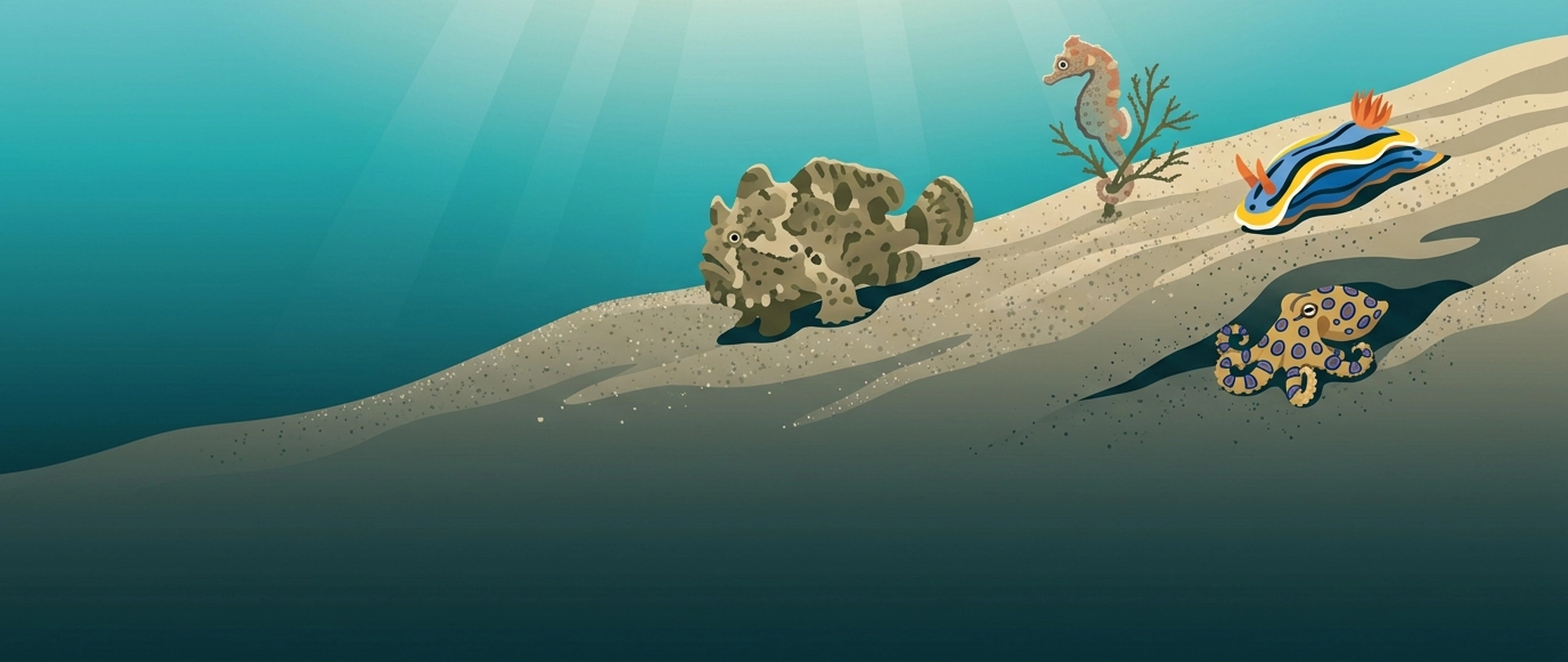
The critters of Semporna
Plan your macro diving week around Mabul, Kapalai and the Semporna mainland.
More details →
Sipadan
Guide to diving Sipadan Island in Sabah.
More details →
Mabul
Mabul is the main island base for Sipadan.
More details →
Macro & Muck
A week on Mabul or Kapalai spent diving the shallow reefs for frogfish, blue-ringed octopus and mandarinfish.
More details →
Conservation in the Semporna islands
Learn how marine parks, strict Sipadan permit limits, turtle hatcheries and active coral restoration protect the reefs of Semporna for visiting divers.
More details →Send your dates, the names of everyone coming and your certification levels. The team comes back with the right island combinations and tells you exactly what can be arranged.