

Malaysia's only oceanic island
A short history of diving at Sipadan
Forty years ago a handful of divers pitched camps on a small island off Sabah. Today nobody sleeps there and a daily permit protects the reef.
Highlights
- Malaysia's only oceanic island rises 600 m from the Celebes Sea floor.
- The colonial government gazetted the island as a bird sanctuary in 1933.
- Pioneers pitched the first commercial dive camps on the beach in 1983.
- Jacques Cousteau filmed the reefs in 1988.
- The government removed all resorts by 31 December 2004 to protect the coral.
- Sabah Parks now issues 254 Sipadan permits a day.
- All diving happens by boat from the neighbouring islands or the liveaboard.
Overview
Forty years ago a handful of divers pitched camps on a small island off Sabah. They found a reef wall that Jacques Cousteau would soon call an untouched piece of art. Today nobody sleeps on the island. A daily permit protects the surrounding waters. The green turtles and chevron barracuda are still there. You reach the drop-offs by boat from Mabul or Kapalai. You dive from early morning until the afternoon. The rules govern every part of a visit. The history explains the rules. The rules are the reason the diving is still this good. If you understand how the island evolved from a frontier beach camp into a strictly regulated marine park you will know how to plan your own trip.
The short version
The modern history of Sipadan involves a rapid shift from commercial exploration to strict marine conservation. The island was formally gazetted as a bird sanctuary by British colonial authorities in 1933. The underwater topography gained global attention only after the first commercial dive operation opened in 1984. A rush of tourism development eventually saw six competing resorts crowded onto the 12-hectare island. The Malaysian government ordered all resort operations to permanently vacate the beaches by 31 December 2004. This mandate was designed to halt severe ecological degradation. Today the area operates under the authority of Sabah Parks. Access to the reef is fiercely protected by a daily permit quota. The system mandates an annual month-long closure every November for reef recovery. The park authorities also enforce a minimum Advanced Open Water certification requirement for all divers.
Geological origins and early protection
The unique geological structure of the island explains the density of the marine life. The island was formed over millennia by living coral. This coral grew atop an extinct submarine volcano. The landmass does not sit on a continental shelf. The reef flat extends only a few metres from the beach before dropping vertically roughly 600 m to the floor of the Celebes Sea. This sheer drop creates localised oceanic upwellings of cold water. The nutrient-rich deep water collides with the sunlit shallows. This collision supports a remarkably dense food web.
The island was legally recognised for its terrestrial biodiversity long before the invention of recreational scuba diving. The marketing narrative claims the island was an undiscovered territory prior to the 1980s. This is historically inaccurate. The Siparan people frequently navigated to the remote island to harvest turtle eggs. The island appeared on Dutch navigational maps as early as the 1840s.
The colonial government of British North Borneo formally gazetted the island as a protected bird sanctuary on 1 February 1933. The legislation protected critical migratory stopovers and resident breeding populations of threatened avian species. The Philippine Megapode is one example of the protected bird species. The Malaysian government formally re-gazetted this sanctuary status in 1963. The 1933 environmental legislation proved crucial decades later. The International Court of Justice awarded full sovereignty of the island to Malaysia in December 2002. The court explicitly cited the early bird sanctuary and continuous conservation management. This served as definitive proof of Malaysian administrative control. The ruling resolved a bitter territorial dispute involving contradictory interpretations of colonial treaties.
Marine biologist Dr Elizabeth Wood conducted extensive coral reef surveys in the Semporna region in 1981. She focused heavily on the island as part of a World Wildlife Fund initiative. Her technical report provided the first full scientific baseline of the hard coral diversity. This foundational data remains the critical baseline. Biologists measure all subsequent ecological degradation and reef recovery against these early records.
The pioneers
The commercial history of the island connects directly to the foundation of Borneo Divers in 1983. Randy Davis and Ron Holland visited Kota Kinabalu to explore offshore reefs in 1982. They connected with Clement Lee and Samson Shak. The men formed an alliance to explore the remote eastern seaboard of Sabah. They began conducting the first exploratory dive camping expeditions in 1983.
The logistics were raw in the early days. The team chartered large transport boats to haul fresh water rations across the Celebes Sea. They brought cooking utensils and heavy dive equipment. They set up temporary beach camps upon arrival.
The reefs of the Semporna archipelago were suffering catastrophic damage from unregulated blast fishing at the time. The physical presence of the pioneer dive team acted as an immediate deterrent. The founders sped out in small dinghies to intercept incoming blast fishers. This initial commercial occupation saved the local reef from immediate destruction via explosives.
Borneo Divers formalised their operations in 1984. They established the first full-service commercial dive resort on the island. They transitioned from temporary tents to a semi-permanent lodge in 1986. They constructed simple A-frame huts using bamboo and thatched roofs. Early working policies mandated the strict use of biodegradable soaps. The operators installed an expensive desalination plant. This prevented the draining of the island's limited natural freshwater lens. They physically removed all solid waste back to the mainland for proper disposal. You can still dive with the company today at Borneo Divers Mabul Resort.
Cousteau and the film
The event that transformed the island into a mainstream global destination was the arrival of Jacques-Yves Cousteau. He navigated his legendary research vessel the Calypso to Sabah in 1988. The crew spent considerable time diving the walls and caverns to film a documentary segment. The resulting film released in 1989 bore the title "Borneo: The Ghost of the Sea Turtle".
The documentary captivated international audiences. It showed spectacular footage of a labyrinthine underwater cave system discovered beneath the island. Cousteau provided a glowing endorsement in the film. He famously described the reefs as "an untouched piece of art".
Marketing brochures routinely deploy the phrase today. The quote was intended as a profound endorsement of the rare biological richness. It was not a declaration of geographic discovery. The pioneer resort operators had already built physical facilities by the time the film crew arrived.
Turtle Tomb
Skill level: Cavern/Cave certification | Entrance depth: 18–20 m | Max depth: 23 m The footage from the 1989 film showed the skeletal remains of numerous sea turtles. These remains were scattered across the sandy floor of a cavern. The biological reality was tragic. Turtles entering the cavern to rest or forage became disoriented in the dark recesses. They failed to find the exit and subsequently drowned from asphyxiation.
The Turtle Tomb entrance sits just east of the main jetty. A bell-shaped descent tunnel opens off the wall at approximately 18 to 20 m depth. Sabah Parks rules are exceptionally strict regarding this site. Entry requires proper overhead environment training and a qualified local guide. Standard recreational divers may only view the entrance from the open water.
The resort years
Word of the 600 m drop-offs spread rapidly through global diving publications. The solitary A-frame lodge had been joined by heavily capitalised competitors by 1990. The number stabilised at six primary operators by the mid-1990s. These operators occupied the limited beachfront real estate.
The rapid proliferation of these resorts initiated a period of severe environmental degradation. Chalets and staff quarters encroached deep into the forested interior. Additional freshwater wells threatened the natural hydrology. Untreated wastewater filtered directly into the surrounding sea. This nutrient runoff spurred the growth of algae. The shallow reef flats began to smother under the strain of hundreds of daily guests.
Tropical Storm Greg lashed the island in 1996. The storm demolished shallow coral structures. These damaged reefs struggled to regenerate due to the compromised water quality. Academic researchers documented the environmental strain. Dr Ghazali Musa published a landmark study in the journal Tourism Geographies in 2002. He analysed diver satisfaction and the social daily cap of the island. Diver satisfaction remained overwhelmingly high at 97.8 percent due to the sheer biological density. The surveys revealed acute concern regarding underwater crowding and noise pollution.
Drop-Off
Skill level: Advanced Open Water | Max depth: 40 m The Drop-Off sits just off the old jetty on the northern beach. The reef flat extends roughly 10 m before dropping vertically into the 600 m deep water. Resident green turtles and patrolling reef sharks are seen on almost every dive. The sheer wall allows open-ocean pelagic species to aggregate remarkably close to the shore. Strict depth discipline is required.
Barracuda Point
Skill level: Advanced Open Water | Max depth: 40 m Barracuda Point is the dive most people come to Sipadan for. The site is located on the northeast corner of the island. Dense pelagic aggregations are common here. The resident school of chevron barracuda tolerates divers. The school often tightens into a column above the wall when the current runs.
Coral Gardens
Skill level: Advanced Open Water | Depth: 14–22 m Coral Gardens features gentler shallow terrain teeming with reef life. You can spot tree corals and crinoids along the slope. The site serves as a relaxing drift dive. Operators often use this area as a final dive of the day to off-gas.
Leaving the island
The unregulated daily cap of the island had been vastly exceeded by the early 2000s. The state government recognised the reefs could not survive the continued physical presence of six competing resorts. These operators were dumping waste and extracting fresh water daily. The authorities executed a historically unprecedented conservation decision.
The Federal Cabinet ordered all 6 dive resort operators to dismantle their structures. The government mandated they vacate the beaches by an absolute deadline of 31 December 2004. Overnight tourist stays on the island were formally and permanently banned effective 1 January 2005.
The eviction triggered a massive practical and economic relocation. The dive operators shifted their headquarters to the nearby islands of Mabul and Kapalai. Mabul rapidly transformed into a densely populated hub of dive tourism. The relocation displaced the environmental burden to the nearby islands. It successfully saved the Sipadan coral walls from total collapse.
The park and the permits
The government formally gazetted the area as the Sipadan Island Park in 2009. This provided strict statutory protection under the Sabah Parks Enactment 1984. The park was expanded in 2015 to cover 16,860 ha of sea and coral reefs surrounding the island.
Sabah Parks introduced a strict daily permit quota system on 1 April 2006 to control day-tripper traffic. The initial permit system capped access at 120 divers per day. The quota evolved over time in response to ecological assessments. The authorities adjusted the limit to 176 per day in 2019. Sabah Parks issues 254 Sipadan permits a day. This total count includes both scuba divers and snorkellers combined. Access is strictly allocated through licensed resorts and dive centres.
The transition to a marine park involved significant challenges. The federal government funded the construction of a concrete clubhouse and public toilets on the island in early 2006. A large steel construction barge transporting heavy building materials ran aground on the shallow northern reef in mid-May 2006. The barge crushed an estimated 324 to 372 square metres of coral. The incident sparked massive public outrage among marine biologists and the dive community. The government immediately issued a stop-work order. This permanently halted the concrete clubhouse development.
South Point
Skill level: Advanced Open Water | Max depth: 40 m South Point is characterised by deeper waters and stronger currents at the southern tip. The site is the primary location for spotting deep-water pelagic species. Scalloped hammerheads (Sphyrna lewini) occasionally aggregate deep at this site. You can spot them with luck during the right season. Large schools of bigeye trevally (Caranx sexfasciatus) often move along the reef here.
Hanging Gardens
Skill level: Advanced Open Water | Max depth: 40 m Hanging Gardens is a vertical drop-off densely upholstered with gorgonian fans and soft pastel alcyonarian corals. You glide along a relatively gentle drift dive here. The wall is rich in macro life.
The rules today
The regulatory environment is arguably the strictest in Southeast Asia. Sabah Parks instituted an annual month-long closure of the island beginning in 2020. The park closes entirely to all visitors every November. No diving or snorkelling is permitted from 1 November to 30 November. This unprecedented policy provides a critical 30-day recuperation period for the marine life. The reef rests completely free from the stress of boat noise and human interaction.
Sabah Parks implemented a strict new regulation regarding diver competency in October 2022. The sheer wall features unpredictable oceanographic currents. Sabah Parks implemented the rule to protect the reef from inexperienced divers. Novice divers pose a safety hazard to themselves and physically damage the coral due to poor buoyancy control. All divers must hold an Advanced Open Water certification or equivalent as a minimum to dive at the island. The rule is non-negotiable. Park rangers check certification cards and logbooks at the registration jetty every morning.
Sabah Parks limits the number of divers at any single dive site to 50 at a given time. Be sure to bring your physical or digital certification card on the boat.
Visiting Sipadan now
You visit the island today as a day trip from your resort. The boat ride from Mabul or Kapalai takes roughly 15 to 25 minutes. You dive from early morning until the afternoon. Night diving is strictly prohibited. A Sipadan permit day gives 3 dives if you stay on Mabul or Kapalai or aboard the Celebes Explorer and 2 dives if you stay on Pom Pom or Mataking.
Sabah Parks rangers are stationed permanently on the island. You step ashore only to register your passport and take your surface intervals. The strict protection keeps the immediate park safe from the blast fishing that affects the wider region. The modern regulatory apparatus frames the island as a rare and successful example of ecological survival.
A guaranteed Sipadan permit comes with the right combination of resort, dive package and minimum nights; which dates can be guaranteed depends on the resort you choose. The team steers you to the combination that fits your schedule. You can read the full breakdown in the Sipadan permits guide. Remember you need a 24-hour no-fly interval after your last dive before heading back to Tawau airport.
Nearby places / alternatives

Sipadan
Guide to diving Sipadan Island in Sabah.
More details →
Borneo Divers Mabul Resort
Stay at Mabul's pioneering dive resort.
More details →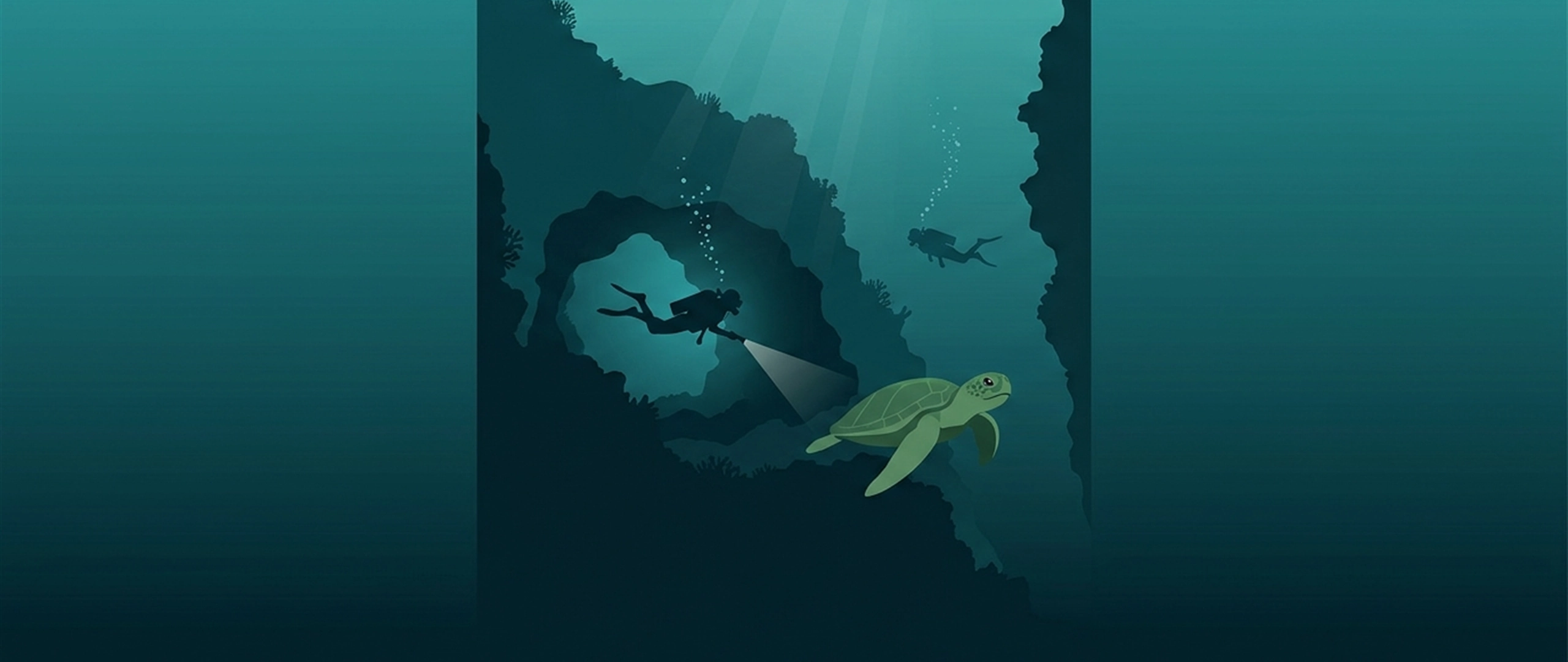
Turtle Cavern and Turtle Tomb
Dive Sipadan's Turtle Cavern and Turtle Tomb.
More details →
Sipadan permits, explained
A complete guide to how the Sipadan permit system works.
More details →
Conservation in the Semporna islands
Learn how marine parks, strict Sipadan permit limits, turtle hatcheries and active coral restoration protect the reefs of Semporna for visiting divers.
More details →Plan your Sipadan trip
Send your planned travel dates and your current certification level. The team comes back with what can be arranged for your time in Sabah.