

Kapalai's famous dusk dive
Mandarin Valley
A gentle coral slope beside the Kapalai sandbank known for its resident mandarinfish and their twilight mating displays.
Highlights
- Located on the reef slope right beside the Kapalai house reef
- Depths from 5 to 20 m to suit all certification levels
- Dusk dives scheduled daily to watch the twilight mating rituals
- Clear water often giving 15 to 30 m of visibility
- Remains of a small fishing boat holding macro subjects
- Reached by a shore entry or a 10-minute boat ride from Mabul
About Mandarin Valley
A gentle coral slope beside the Kapalai house reef runs down to the sand past sea urchins, small coral bommies and the scattered remains of a fishing boat. This is where mandarinfish shelter among the long urchin spines by day and rise to display as the light goes. It sits right on the edge of the sandbank. The dive gives you a calm twilight profile with plenty of time to wait for the action.
Skill level: Open Water | Ave depth: 15 m | Max depth: 20 m | Current: Weak | Visibility: 15–30 m
The slope and the mandarinfish
The site sits on the Ligitan reefs where the topography consists of a vast sand flat rather than a steep wall. The lack of a terrestrial landmass above the Kapalai resort means the water holds far less sediment. Mandarin Valley has excellent visibility ranging from 15 to 30 m, usually better than Mabul's slopes. The gentle coral slope descends gracefully to a sandy bottom dotted with diadema sea urchins.
The main event is the Synchiropus splendidus or mandarinfish. These small fish rely entirely on the defensive spines of the sea urchins. They spend the daylight hours securely hidden deep among the urchin spines. The reef slope also holds the scattered remnants of a small fishing boat wreck. This debris acts as an artificial reef and creates a complex habitat for other macro species. You often find a lot of life concentrated around these wooden remains. Conservationists and resort operators actively engineered this environment. They placed these structures on the sandy plateau to stimulate biomass and attract marine life. This intervention successfully transformed the barren sand slope into a highly productive habitat.
How the dive is run
The timing is strict. Operators run this dive at dusk to coincide with the twilight mating rituals. The resort schedules the dusk dive at 17:30. You can access the site directly from the shore if you stay at the Sipadan-Kapalai Dive Resort. Divers coming from Mabul take a short ten-minute boat transit across the channel.
The boats are 35- to 40-foot monohull speedboats. Kapalai's boats carry up to 12 divers. You make a giant stride entry and descend slowly to the slope. The guide leads you to the specific coral bommies holding the most active fish. The current is generally weak. You can settle comfortably on a patch of bare sand beside the target urchins. The dive consists mostly of waiting quietly as the light fades. The bottom time is often long because the profile is very shallow. The resort schedules a separate night dive at 18:30 after a surface interval. On the night dive, you switch on your main torches and move slowly up the slope. This is a great introduction to night diving in Semporna.
What you look for
The mandarinfish rise from the urchin spines to mate just as the ambient light drops. You can search the surrounding sand and rubble while you wait for them. You often find crocodilefish Cymbacephalus beauforti resting flat against the substrate. Look for leaf scorpionfish swaying gently along the sand and longnose hawkfish resting on the coral blocks.
The environment creates a haven for bottom-dwellers. Look for well-camouflaged flatheads in the sandy patches between the coral bommies. You can look for small groups of razorfish moving vertically over the rubble. These subjects demand slow movements and a sharp eye.
The scattered wreck debris is highly productive for cephalopods. You can look for the cuttlefish hiding in the man-made crevices. Look for small cuttlefish hovering over the rubble patches and juvenile frogfish gripping the sponges. You must also watch closely for venomous stonefish heavily camouflaged against the reef. Small cleaning stations operate on the coral blocks.
Photography
This is strictly a macro site. You want a dedicated macro lens to capture the small details of the fish and crustaceans. The shot the site is known for is the mandarinfish mating pair rising together from the urchin. Capturing this requires patience and strict etiquette.
Mandarinfish are shy and easily spooked by bright lights. You need to use a red focus light on your camera rig to avoid frightening them back into the spines. The most important rule for underwater photography here is to withhold strobe firing until the mating sequence initiates. Flashing early will interrupt the biological process and ruin the opportunity for the whole group. You must exercise precise buoyancy control. Frog-kicking techniques help you avoid creating silt-outs on the sandy bottom. A cloud of sediment ruins visibility for subsequent dive groups.
The level it asks for
The site asks for an Open Water certification. The shallow depth and the weak current make it a very relaxed dive. The main skill you need is precise buoyancy control. You spend a lot of time hovering motionless close to the bottom.
The environment has a plenty of venomous stonefish and sea urchins. You need to stay neutrally buoyant and avoid touching the reef. Be sure to check what is beneath you before you settle on the sand to watch the display. Good finning techniques stop you from kicking up sediment and ruining the clear water for the divers behind you.
When it is best
The only time to see the signature mating dance is at dusk. You need to be in the water at 17:30 as the light begins to fade. You can dive here all year. The clearest water usually arrives between March and October. Mid-February to mid-November is good diving with softer visibility at the ends of the season. The rest of the year brings a mix of cloud, rain and sun. The resort operates a strict no-gloves policy to protect the reef.
How to dive it
You dive this site on macro and muck itineraries based around the Kapalai sandbank. The easiest way to reach it is to stay at the resort right on the reef. You can also dive it easily from the premium resorts on the east side of Mabul. The dive packages bundle your accommodation, your meals and your boat diving into one rate. Most people spend a few days exploring the local macro sites before taking a boat out for a day of diving in Sipadan. The resort at Kapalai does not provide enriched air nitrox so you do all your dives on standard compressed air.
Nearby sites

Kapalai house reef
Dive the Kapalai house reef directly from your water chalet.
More details →
Paradise 1 and Paradise 2
Dive Paradise 1 and 2 off Mabul Island.
More details →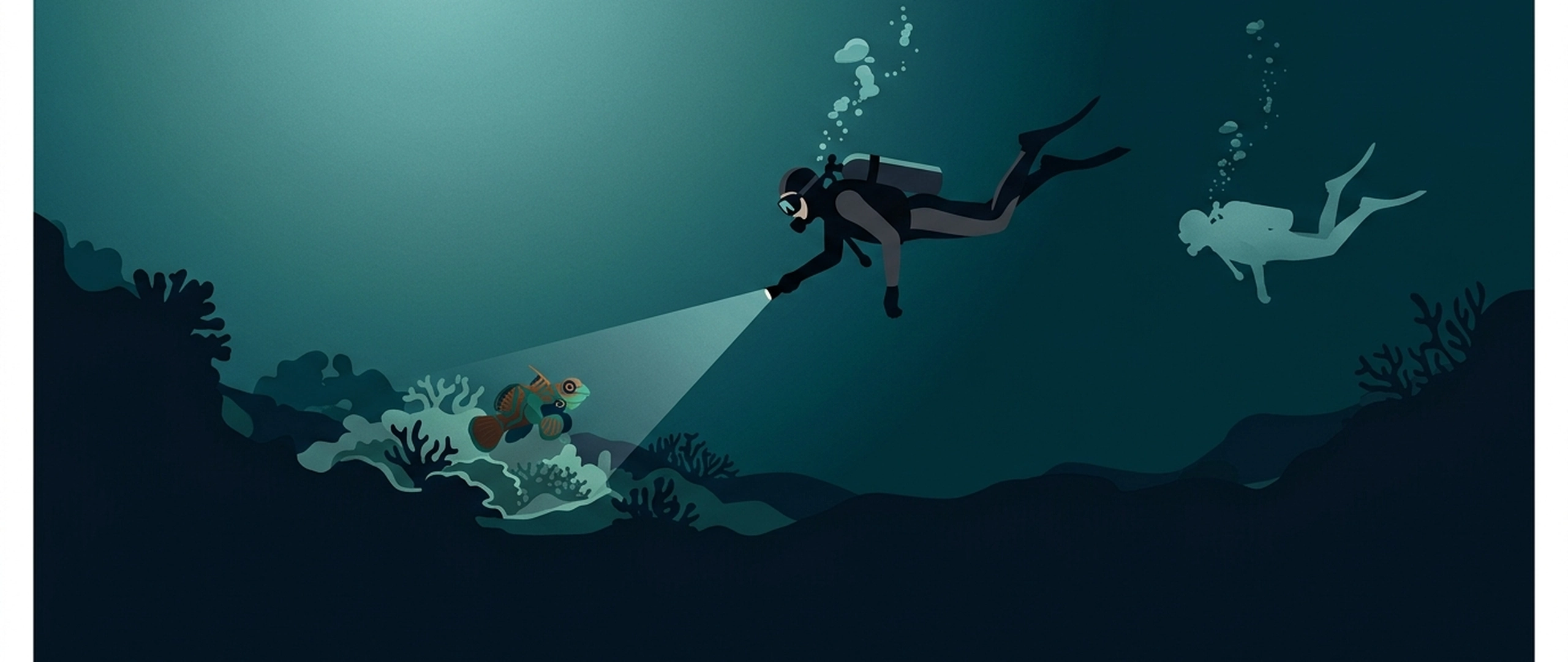
Mabul house reefs
The waters under Mabul's resort jetties hold some of the best macro diving in Sabah.
More details →
Kapalai
Stay at a water village built on a submerged sandbank off Mabul.
More details →
Mandarinfish
Learn where to find mandarinfish in Sabah.
More details →Plan your dives
Send your dates, the names of everyone coming and your current certification levels. The team will come back to you with the resort packages and boat schedules that can be arranged. The team handles the travel information and the transfers so you can focus on the diving.