

Macro marine life guide
The critters of Semporna
What actually lives on the sand and rubble around Mabul, Kapalai and the Semporna straits. Plan your dive week around the animals you want to photograph.
Highlights
- Dedicated muck diving across Mabul, Kapalai and the mainland Semporna straits.
- Resident frogfish, flamboyant cuttlefish and blue-ringed octopus.
- Unparalleled nudibranch biodiversity in the coastal silt.
- Shallow depths and mild currents suited to long bottom times.
- Dusk and night diving for mandarinfish mating rituals and nocturnal cephalopods.
- Expert local spotters who know where specific animals live.
Overview
Around an hour by boat from the mainland, Mabul and Kapalai give you some of the most productive muck diving anywhere in the ocean. The shallow sand flats and artificial reefs here host a concentration of marine life you rarely see on a coral wall. If you want to spend a week photographing flamboyant cuttlefish and blue-ringed octopus you are looking in the right place.
The environment is highly specific. You will dive over fine volcanic sand, broken coral rubble and sunken wooden boats. Almost none of these animals are seen by divers alone so the guide who knows the reef is the difference between a long list of species and an empty logbook. The animals hold territories for weeks at a time. The local divemasters memorise their locations and lead you straight to the subject. You dive slowly here. A single patch of rubble can hold enough life to keep a camera busy for an hour.
Why the Semporna islands for critters
The macro diving in this region divides into two distinct environments. Mabul and Kapalai represent classic offshore muck diving. The topography features gentle slopes of natural volcanic sand, patchy seagrass and complex artificial reef structures. Cuttlefish, octopus and ghost pipefish are regularly found here.
The Semporna mainland muck sites present a radically different environment. In the Semporna Straits and along the near-shore fringes of Bum Bum Island you dive over silt and rubble. The substrate consists of dense silt and heavy concentrations of human refuse including discarded tyres and glass bottles. These sites are home to exceptionally small invertebrates. The mainland's concentration of rare sea slugs draws photographers who enjoy searching slowly through the silt. The fauna here adapts to the refuse for shelter and camouflage. An independent assessment published in the consumer publication Undercurrent in June 2025 documented an average of 15 to 20 nudibranchs per dive on the Semporna mainland.
Cephalopods
The sandy slopes of Mabul and Kapalai are hunting grounds for highly sought-after cephalopods. The flamboyant cuttlefish (Metasepia pfefferi) inhabits the open sand flats of Awas Reef and the Kapalai House Reef. They walk across the sand. When they hunt they display bright warning colours that signal their toxic flesh. Observers approach low and slow to avoid disturbing them.
The blue-ringed octopus (Hapalochlaena spp.) is an occasional find in the rubble at Froggy Lair and Seaventures. These lethally venomous animals shelter in empty shells or discarded glass bottles on the sand. You observe them from a safe distance maintaining strict neutral buoyancy. Rare cephalopods including the mimic octopus and the wonderpus are recorded periodically by eagle-eyed guides on the sandy expanses of Awas Reef. Bobtail squid and reef octopus are regular sightings when you search the shallow crevices during night dives.
Fishes
The artificial reefs and sandy slopes host a complex roster of cryptic fishes. The frogfish (Antennarius spp.) is a permanent fixture across the islands. Giant, painted and clown frogfish are resident at Froggy Lair where they use discarded tyres as nurseries. They rely entirely on camouflage and rarely move. Your guide can often locate the same individual across multiple days. Painted frogfish exhibit a colour burst as adults. Photographers often wait long periods to capture their yawning behaviour.
The mainland straits hold even rarer variations. Semporna Macro Critters (SMC) is a specialist mainland operation that has documented an exceptionally rare green variant of the cryptic frogfish (Histiophryne cryptacanthus) hiding deep in the coastal rubble. The animal requires tight focus on its eye and luring apparatus.
Ghost pipefish are frequent seasonal visitors. The ornate ghost pipefish (Solenostomus paradoxus) shelters in the feather stars covering the sunken wooden boat at Paradise 1 & 2. A different variation called the leafy seadragon pipefish (Halicampus macrorhynchus) lives in the mainland sand. It mimics dead seagrass and requires a very shallow depth of field to photograph. On the northern side of Mabul Crocodile Avenue is the most reliable habitat for the crocodilefish (Cymbacephalus beauforti). They lie completely flat on the sand to ambush prey.
The seahorse family is heavily represented across the reefs. Clinging seahorses anchor themselves to stringy weed patches on the sandy slopes. The highly prized pygmy seahorse (Hippocampus bargibanti) is frequently found in the gorgonian sea fans growing directly on the steel pylons beneath the Seaventures rig. Eel Garden at the southern end of Mabul hosts massive colonies of garden eels. They emerge at the sand-reef interface and sway like grass in the current. If you exhale heavily or vibrate the sand they will shrink into their burrows instantly. Blue ribbon eels (Rhinomuraena quaesita) are resident at Ribbon Valley where they pop their heads from the sand terraces. The picturesque dragonet (Synchiropus picturatus) is an occasional alternative to the mandarinfish. It lives in the shallow rubble near mainland jetties and becomes active in the late afternoon.
Crustaceans
The specific micro-habitats around Mabul support an array of specialised crustaceans. Harlequin shrimp (Hymenocera picta) are occasional finds among the metal structures of the Mabul House Reef. They are highly active predators that feed exclusively on starfish. Panglima Reef is the primary location for orangutan crabs (Achaeus japonicus). These crabs reside exclusively within the sweeping arms of bubble corals. The mismatched pompom crab (Lybia leptochelis) is an occasional find in the rubble. It carries small living anemones in its claws for defence and frequently retreats under rocks.
The mainland silt sites hold even stranger oddities. The granular pearl purse crab (Heteronucia perlata) is a rare find for guides. It relies on absolute immobility and closely resembles a sugar-coated biscuit. The one-armed Polyonyx crab is a commensal species that lives inside the tubes of tube anemones. It features a single massively oversized claw used for defence. An arbur boxer shrimp (Odontozona arbur) is a rarely seen species that hides in mainland crevices. It is highly skittish so it requires a slow indirect approach and low lighting.
Nudibranchs and the Spanish dancer
The sheer volume of sea slugs in this region draws photographers from around the world. Mabul sites deliver collections of colourful nudibranchs along the walls and artificial reefs. The Semporna mainland is especially rich in sea slug species.
Specialist spotters document an astonishing list of species here. The Pikachu nudibranch (Thecacera pikachu) is a regular find. Its bright yellow and black body makes it a highly forgiving subject for novice macro photographers. The Tiger Trapania (Trapania tigger) moves rapidly across the rubble while the bizarre Melibe engeli uses a translucent expanding oral hood to feed.
Extreme micro-species require heavy magnification. The Ruby Stiliger (Stiliger sp.) is a deep red sap-sucking slug barely visible to the naked eye. The Rosey Miamira (Miamira alleni) is a deep pink morph that remains highly cryptic when situated on host sponges. It requires an extreme macro setup to capture accurately. The Candy Land Phyllidiopsis (Phyllidiopsis cardinalis) displays complex geometric patterns across its body. It is best photographed straight down to capture the geometric symmetry. The peachy lemon favorinus (Favorinus mirabilis) is an egg-eating specialist that actively feeds on the egg ribbons of other sea slugs.
The Spanish dancer (Hexabranchus sanguineus) is a large dramatic nudibranch occasionally found on night dives. When disturbed it swims through the water column with a rhythmic undulating motion that exposes its red mantle.
Where each one is found
The operators rely on specific sites to locate specific animals. Use the table to choose sites for the animals you want to photograph.
| Animal | Primary Sites | How Often |
|---|---|---|
| Mandarinfish | Paradise 1 & 2, Awas Reef | Resident |
| Frogfish | Froggy Lair, SMART Artificial Reef | Resident |
| Crocodilefish | Crocodile Avenue, Seaventures | Resident |
| Ribbon Eels | Ribbon Valley, Eel Garden, Paradise | Resident |
| Garden Eels | Eel Garden, Crocodile Avenue | Resident |
| Flamboyant Cuttlefish | Awas Reef, Froggy Lair, Kapalai House Reef | Frequent |
| Pygmy Seahorse | Seaventures Platform | Frequent |
| Orangutan Crab | Panglima Reef | Frequent |
| Blue-Ringed Octopus | Froggy Lair, Seaventures Platform | Occasional |
| Harlequin Shrimp | Borneo Divers House Reef | Occasional |
The guides' role in finding them
A macro dive relies entirely on the local knowledge of the guide. Extreme micro-species like the Ruby Stiliger are invisible to the untrained eye. Photographic success requires trust in the spotters. You can spend an entire 60-minute dive exploring just 10 metres of sand.
Your guide searches the rubble carefully for tiny subjects. When the guide locates a nudibranch on a rock or piece of coral rubble you approach it where it lives. You take time to compose your shot and adjust your lighting before making room for the next photographer. For immovable or fragile subjects like frogfish or delicate aeolid nudibranchs the guide will signal you to approach the animal in its natural position. Watch for the moment your guide reaches for a camera. When the spotter stops to photograph a specimen it signals that the find is highly unusual or scientifically significant.
Key macro dive sites
The dive sites around Mabul and Kapalai are tailored for long shallow explorations.
Awas Reef
Skill level: Open Water | Ave depth: 9 m | Max depth: 15 m Located on the southern side of Mabul this site takes place almost entirely on a barren sandy slope navigated by moving between mooring buoys. It is an undisputed haven for snoot photography. The signature species include the flamboyant cuttlefish, fingered dragonets and flying gurnards. Rare cephalopods like the mimic octopus are occasionally sighted here.
Froggy Lair
Skill level: Open Water | Depth: 5–10 m Situated off the edge of the island's local jetty the seabed is a sprawling silty expanse littered with discarded old tyres. The site strictly ranges from 5 to 10 metres. The signature resident species are giant, painted and clown frogfish in myriad colours.
Crocodile Avenue
Skill level: Open Water | Depth: 5–20 m A gentle sandy slope peppered with small weed patches on the northern side of Mabul. The resident signature species is the crocodilefish which employs brilliant camouflage to lie flat and ambush prey. The stringy weed patches are frequent habitats for clinging seahorses while snake eels protrude from the deeper sand flats.
Seaventures Platform
Skill level: Open Water | Depth: 12–18 m Situated directly beneath a decommissioned oil rig elevated above the Celebes Sea. The underwater environment is a post-industrial artificial reef consisting of massive steel rig pylons and metal debris. Pygmy seahorses reside in the gorgonian sea fans growing directly on the steel pylons while giant moray eels and frogfish shelter in the rubble. Guests of Seaventures reach the water by hydraulic lift.
Photography and etiquette
Mabul and Semporna are definitive super-macro destinations. The environment is highly conducive to snoot photography. By isolating a subject with a narrow beam of light against a black background you can minimise ambient light scattering and highlight the texture of a small animal. A 60mm or 105mm macro lens is the standard choice. Wide-angle lenses are generally ineffective on the sandy slopes because the suspended particulate matter creates heavy backscatter.
Strict etiquette applies to every dive. Nothing is moved and nothing is touched by the diver. Hold your position in the water without resting on the reef. Pointing sticks and reef hooks are strictly prohibited on living substrate. Fin discipline is paramount. You must employ a strict frog-kicking technique because a standard flutter kick will instantly blind a site with suspended silt and bury the micro-habitats of the bottom-dwelling subjects. You must avoid repeated strobing of a single animal to prevent stress. This is particularly important for cephalopods and seahorses.
Dusk and night
The transition from day to night triggers specific behavioural changes across the reefs. Paradise 1 & 2 at Mabul and Mandarin Valley at Kapalai are globally famous for their dusk rituals. At dusk resident mandarinfish (Synchiropus splendidus) often emerge from shelter to perform a twisting upward mating dance. Capturing the mandarinfish requires extreme patience and the use of a red-light focus lamp. Standard white focus lights will cause the fish to retreat into the branches instantly. You also need precise buoyancy to hover over the fragile staghorn corals in dim light.
After dark the sandy expanses of Awas Reef and Crocodile Avenue come alive with nocturnal crustaceans and hunting cephalopods. The Seaventures house reef is widely considered a premier night dive because the metal structures provide excellent shelter for predators like groupers and lionfish.
When to come
Macro diving in Sabah works all year. The water temperature stays between 26 and 30 degrees Celsius regardless of the month so you will be comfortable during long slow dives. The Macro & Muck packages run continuously. While the oceanic drop-offs of Sipadan are closed every November to allow the reef to rest, you can keep muck diving around Mabul, Kapalai and the Semporna mainland.
Nearby places and alternatives

Macro & Muck
A week on Mabul or Kapalai spent diving the shallow reefs for frogfish, blue-ringed octopus and mandarinfish.
More details →
Underwater Photography
Photograph Sipadan's wide-angle pelagics and Mabul's macro critters in one week.
More details →
Mabul
Mabul is the main island base for Sipadan.
More details →
Kapalai
Stay at a water village built on a submerged sandbank off Mabul.
More details →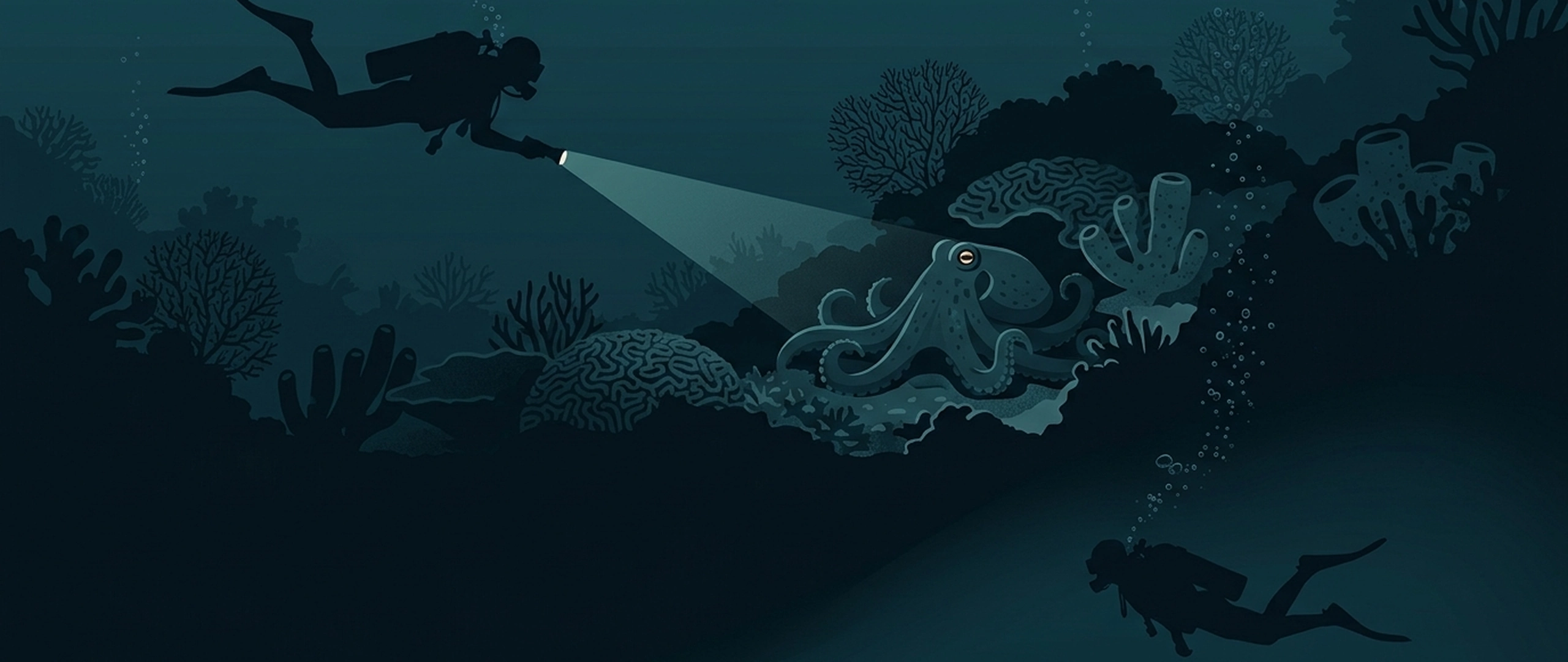
Night diving in the Semporna islands
Everything you need to know about night diving in the Semporna islands from dusk mandarinfish dives to the Seaventures rig.
More details →Send your dates, the names of everyone coming and your certification levels. The team will come back with a detailed itinerary and advise on the best resort base for the specific animals you want to see.